Stronger Together

Help Develop the Plan for a Safer, More Resilient Island  

Preparing for Flooding, Earthquakes, and Aging Infrastructure

Our quality of life depends on infrastructure that works. Today, much of Alameda’s infrastructure is aging and increasingly vulnerable to flooding, earthquakes, and severe weather. 

  • Flooding and Sea Level Rise: As an island community, we are on the front lines of rising seas. Our outdated storm drains are too small for today’s conditions, causing more frequent street flooding during storms and high tides. 

  • Earthquake Safety: Our bridges and fire stations were built decades ago and don’t meet today’s seismic safety standards, leaving us vulnerable in a major earthquake. 

  • Poor Street Conditions: Potholes, cracked sidewalks, and traffic safety needs make it harder for everyone – especially older adults, students, and people with disabilities – to get around safely. 

Maintaining the City of Alameda’s financial stability is a top priority, but the City’s existing financial resources are not sufficient to address these growing infrastructure needs. 

Potential Local Funding Solutions to Protect Alamedans

While no final decisions have been made, one option being explored is a $300 million local bond measure that would provide a dedicated funding source for our critical infrastructure needs. If passed, property owners would pay approximately $49 per year for every $100,000 of assessed value (not the home’s current appraised value), while bonds are outstanding. If approved by voters, the measure could fund identified infrastructure needs, including:  

  • Preventing flooding in the Tubes and on City streets and addressing sea level rise 

  • Providing earthquake-safe backup power so our bridges can operate during emergencies and power outages 

  • Repairing potholes and improving traffic safety 

  • Maintaining and repairing sewer and stormwater infrastructure to keep pollution out of the Bay and prevent flooding 

  • Supporting public safety response to critical fires, crashes, and medical emergencies 

Local Control and Fiscal Accountability

  • All funds would stay local for Alameda — no funds could be taken by the State or federal government 

  • An independent citizens’ oversight committee and mandatory annual audits would ensure all funds are spent as promised  

  • No funds would be used to increase salaries or pensions 

Learn More & Take Action!

Take a survey and share your priorities 

Read Answers to Frequently Asked Questions

Download a Fact Sheet

Download a mailer that was sent to Alameda residents


20240625-190400-Alameda-infrastructure-FireStation2 (1).jpg
20240930-081943_Alameda-Infrastructure-StreetBonding-Striping-Crosswalks-Bikelanes-mrz.jpg
20250713_123109_CityofAlameda-Comms_Woodstock-WaterShuttle-Anniversary-BoholCirclePark-mrz.jpg
20250812-080650_Alameda-BayFarmIsland-bikebridge-mrz.jpg
240313-092613_Alameda-PublicWorks-ADA-sidewalkdisrepair-GibbonsDr.jpg
faas facility.jpg

Streets and Traffic Safety

The City of Alameda manages 127 miles of roads — and every mile matters. From filling potholes and repairing sidewalks to improving bike lanes and crosswalks near schools, the City is investing in safer, smoother travel for everyone.

Join us for a City Council Study Session on Tuesday, September 2 where we will address the aging and deteriorating infrastructure of our Streets and Traffic Safety needs, including:

  • 128 miles of publicly maintained streets
  •  89 signalized intersections, many nearing the end of their useful life
  •  25 million square feet of pavement
  •  7000+ streetlights
  •  25,000+ street trees
  •  260 miles of sidewalks
  •  18 miles of multi-use trails, many substandard and deteriorating
  •  59 miles of existing bikeways

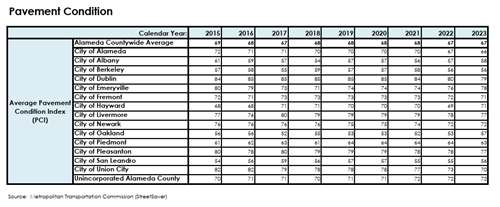
Despite our ongoing efforts, the City’s Pavement Condition Index (PCI) has steadily declined. The 2024 Alameda County Transportation Commission (CTC) Performance Report, published in April 2025, rated Alameda’s pavement a 66, or “fair,” placing us below the County average, and behind the neighboring cities of Union City, Pleasanton, Newark, Livermore, Hayward, Fremont, Emeryville, and Dublin. The decline in our PCI demonstrates that current funding is not sufficient to maintain our existing infrastructure, let alone fund new projects.
pavement condition.png


The City’s deferred maintenance backlog is extensive. Our current funding is insufficient to maintain the status quo and is not enough to address new unfunded infrastructure needs identified in Vision Zero Action Plan, Annual Transportation Work Plan, Active Transportation Plan, Transportation Choices Plan, and ADA Transition Plan.

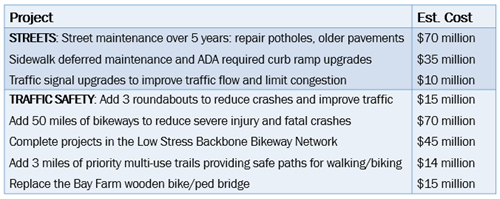
City staff have identified the following unfunded projects that would significantly improve the conditions of our streets and traffic safety (all costs are estimates): 
updated project table.png

City Facilities, Public Safety

Join us for a City Council Study Session on Tuesday, October 7, where we will discuss Alameda's civic and fire facilities infrastructure needs and preliminary findings and recommendations from the City of Alameda Draft Facilities Plan.

The City's aging and deteriorating infrastructure, including the following civic and fire facilities, requires significant investment in current and future needs:

  • Animal Shelter

  • Fleet Service Garage

  • Maintenance Service Center

  • Recreation and Parks Corporation Yard

  • Fire Station 1 and its adjacent Fire Administration Building; Fire Stations 2, 4, and 5; and the Fire Training Facility

These major operational facilities require more in-depth space planning, siting, and feasibility analysis due to aging existing buildings and updated professional or seismic standards, represent areas of growing demand for services, and are impacted by encroaching residential uses. Additionally, the level of effort required for upgrades to these facilities exceeds the capacity of the City’s annual Capital Improvement Plan (CIP) process. 

Libraries, Recreation and Parks

Current funding is insufficient to maintain the status quo and is not enough to address new unfunded needs identified in the Strategic Plan. This report focuses on the infrastructure needs for the City’s existing Libraries and Recreation Facilities and City Parks, which include:

  • Main Library and two existing Branch Libraries (West End and Bay Farm)
  • 35 City parks totaling 300 acres
  • 12 recreation centers
  • 14 outdoor restroom buildings
  • 3 boat ramp/docks
  • 19 sport fields
  • 15 tennis courts
  • 8 pickleball courts
  • 17 basketball courts
  • 4 specialty facilities (Mastick, Veterans, O’Club, Alameda Point Gym)
  • 10 miles of sidewalks and trails
  • 26 playgrounds
  • 4 pools
  • 2 dog parks
  • 1 skate park
  • Golf Complex - Managed by Operator under a lease agreement with the City

Read more from the City Council Study Session on Libraries, City Parks and Recreation Facilities that took place Tuesday, November 4, 2025.

Flood Protection, Sea Level and Ground Water Rise, Disaster Preparedness

The City of Alameda is highly vulnerable to climate hazards. Sea levels and groundwater tables are rising, and storms are increasing in intensity.

Today, much of Alameda’s shoreline is vulnerable to flooding from both shoreline overtopping during coastal storms and from rainfall within the City. In the near term, both are likely to be temporary in nature, depending on high tide cycles and intensity of events, with flooding likely shallow - on the order of two feet or less in depth. However, as climate change increases the intensity of storm events, sea levels, and groundwater levels, the depth and extent of flooding is expected to increase and may become more frequent or permanent. Much of Alameda’s shoreline is built on bay fill over former tidal marshland, leaving it especially exposed to coastal flooding and shoreline erosion.

Today’s 100-year floodplain is approximately equivalent to three feet of sea level rise, encompassing over $1.7 billion in land value and $1.4 billion in building value. Rising groundwater and stormwater inundation increase risks to utilities, roadways, and storm drain systems, particularly in Alameda’s low-lying interior areas. Recent storms, including the December 2024 storms that coincided with King Tides, are impacting Alameda’s shoreline today.

Read more from the City Council's Study Session on Flood Protection, Sea Level and Groundwater Rise, and Disaster Mitigation that took place on Tuesday, December 2, 2025.